
A bold textual statement, anchored around a quote attributed to former Bangladeshi Home Minister Asaduzzaman Khan Kamal, linking the tiny island of St Martin’s Island (Bangladesh) to major geopolitical concerns involving the CIA and the leadership of the subcontinent — notably Sheikh Hasina of Bangladesh, Narendra Modi of India and Xi Jinping of China.
The core message: "American interests are best served with weaker governments. But there was a more immediate reason – St Martin’s Island."
This text presents several intertwined themes: strong leadership, great-power intelligence operations, regional geopolitics, and the strategic significance of a relatively little-discussed island.
In what follows, I will unpack the meaning behind this narrative, examine the major elements and implications, show how they intersect in the context of Bangladesh and South Asia, and reflect on what this suggests for policy, national sovereignty and regional competition.
A Bangla translation of key phrases will be provided where useful to assist bilingual publication.
2. Parsing the Key Statement
“How would the CIA operate if such strong leaders rule the subcontinent? … American interests are best served with weaker governments. But there was a more immediate reason – St Martin’s Island.”
(Quotation from Asaduzzaman Khan Kamal, as cited in media reports).
a) Strong leadership in South Asia
-
The text frames the presence of “strong leaders” — namely Modi, Xi and Hasina — as a challenge to U.S. intelligence operations.ᅟ
-
It suggests that the CIA (and by extension U.S. strategic influence) prefers “weaker governments” in the subcontinent — implying that strong independent leadership could complicate U.S. agendas, potentially because such governments may pursue autonomous policies, resist external pressure, diversify partnerships (e.g., China, Russia, regional blocs), or seek greater strategic bargaining power.
b) The invocation of St Martin’s Island
-
After reference to the broad challenge of strong leadership, the text adds: “But there was a more immediate reason – St Martin’s Island.”
-
This signals that beyond the general strategic concern, there is a tangible, geographically-specific interest at play — in this case, the island in the Bay of Bengal.
-
In short: it is not just about leadership, but about location and strategic asset.
“কিন্তু তৎক্ষণাৎ আরও একটি কারণ ছিল — স্ট মার্টিনস দ্বীপ।” (Bangla)
-
The layering of the statement suggests a narrative: that the U.S., via the CIA, might view the control or influence over St Martin’s Island as a strategic objective — and the presence of strong leadership in Bangladesh, India and China may stand in the way of such ambitions.
3. Why St Martin’s Island Matters — Strategic & Geopolitical Dimensions
The assertion about the island is not purely rhetorical; it taps into documented strategic analyses of the region. Below are key dimensions explaining why St Martin’s Island features as a “more immediate reason.”
a) Strategic Location in the Bay of Bengal
-
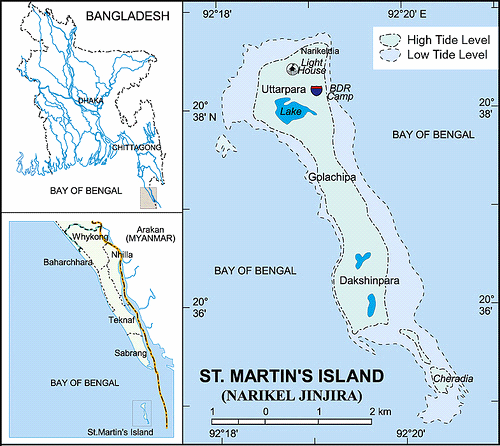
The island lies near the mouth of the Naf River, close to the maritime boundary between Bangladesh and Myanmar, and in the Bay of Bengal — a gateway between the Indian Ocean and Southeast Asia. indusresearch.in+2Firstpost+2
-
It is proximate to vital sea-lanes, including those that serve trade and energy transport between the Indian Ocean, Southeast Asia and beyond. indusresearch.in+2Firstpost+2
-
Control (or influence) in this area offers surveillance advantages: monitoring maritime traffic, project naval or intelligence presence, or serve as a listening post. Firstpost+1
-
For Bangladesh, the island lies within its Exclusive Economic Zone (EEZ), making it relevant for resource rights and maritime governance. @mathrubhumi+1
b) Natural Resources & Territorial Economics
-
The waters around St Martin’s Island are biologically rich: Bangladesh’s only coral reef, numerous fish species, turtles and other marine life are found there. newsroom.wcs.org+2UNDP+2
-
While not always front-page energy hotspot, the maritime zone yields fisheries and potentially other marine resources, which adds economic stakes to strategic ones. CivilsDaily+1
c) Regional Power Dynamics — China, India, U.S., Myanmar
-
As China expands its naval and maritime footprint (through projects like the Belt and Road Initiative, port investments, submarine and naval cooperation) in the Indian Ocean and Bay of Bengal, other major powers (India, U.S., Australia, Japan) are increasingly attentive to maintaining influence and monitoring Chinese moves. Firstpost+1
-
The island’s proximity to Myanmar (which itself borders China’s interests in the region, including the China-Myanmar corridor) gives it additional relevance in the context of regional maritime security. d197for5662m48.cloudfront.net+1
-
The argument advanced by the quoted text is: if the U.S. (via the CIA) sought a base or a listening/monitoring station in this region, a place like St Martin’s Island would be a high-value target. Indeed, media commentary has suggested that the U.S. had interest in the island. Firstpost+1
d) Sovereignty, Strong Leadership & Strategic Autonomy
-
The text frames strong leadership — for example, Sheikh Hasina in Bangladesh — as a barrier to foreign intelligence/power operations. Part of that barrier is leadership insisting on national sovereignty, independent foreign policy, and selective cooperation rather than full alignment.
-
Bangladesh has in recent decades sought to diversify its partnerships: with China, Russia, India, Japan, and multilateral institutions. A leader who resists being locked into a mono-ally relationship is potentially more difficult to work with from the perspective of an external intelligence service that seeks privileged access or bases.
-
In that context, the question posed in the quote: “How would the CIA operate if such strong leaders rule the subcontinent?” becomes meaningful. The implication: operational space is reduced when the host state is assertive.
4. The Narrative in Context of Bangladesh’s Domestic Politics
a) The quoted source
-
The quote comes from Asaduzzaman Khan Kamal, a former Home Minister of Bangladesh. He alleged that the US (via the CIA) contributed to efforts to remove Sheikh Hasina from power, citing her refusal to compromise on St Martin’s Island among other reasons. Moneycontrol+1
-
According to him, Hasina had been told by U.S. interlocutors that her political survival depended on handing over the island. Moneycontrol
b) Implications for Bangladesh
-
The suggestion that a major foreign intelligence agency targeted Bangladesh’s leadership for removal — with the pretext of gaining control of a piece of territory — is highly significant for national sovereignty discourse.
-
If taken at face value, the narrative advances that geopolitics, intelligence operations and the bending of domestic political processes are interconnected.
-
For Bangladesh’s public and for the international audience, this frames a “battle” not just of infrastructure or economics, but of autonomy, influence and external leverage.
-
The idea that “strong leaders” are problematic for external agencies also valorizes Sheikh Hasina’s leadership in this frame (seeing her as someone resisting external pressure).
c) Critiques and caveats
-
It should be noted that assertions about the CIA’s direct intervention or demand for St Martin’s Island are contested; they rest largely on interviews and insider claims, not publicly declassified documentation. For example, the U.S. State Department has denied any discussion about acquiring the island. Reddit+1
-
Some analysts argue that the strategic value of such a small coral island (with natural, environmental constraints) may be overstated. Reddit+1
-
Therefore, while the narrative is powerful, from a critical academic perspective one must differentiate between plausible strategic interest, public allegation, and verified intelligence operations.