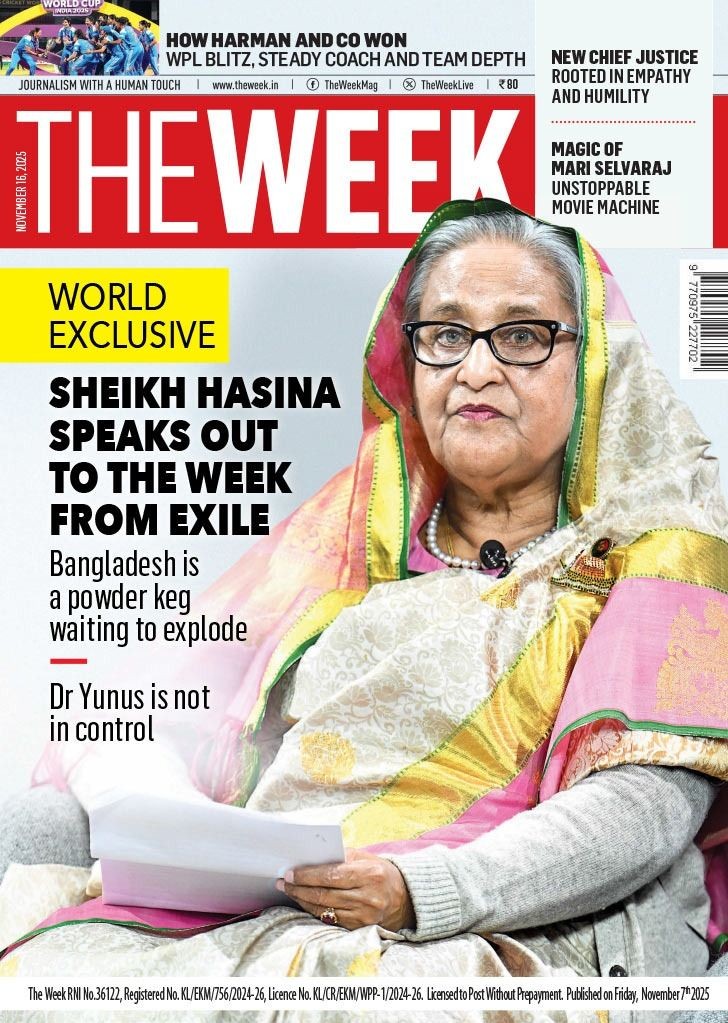
What the World Called a Revolution Was in Fact a Coordinated Terror Assault on Bangladesh” — An Analytical Report on Sheikh Hasina’s Statement
1. Not a Revolution, but a Terror Attack
Prime Minister Sheikh Hasina described the so-called “student revolution” not as a genuine democratic uprising, but as a meticulously planned terror assault aimed at destabilizing Bangladesh. According to her, the violence and disorder witnessed under the guise of student protests bore the hallmarks of organized subversion rather than spontaneous civic action.
She argued that legitimate youth grievances were hijacked and manipulated by extremist elements, using the language of revolution to camouflage destructive intentions. This framing redefines the protests as part of a broader campaign to undermine the Bangladeshi state — politically, institutionally, and symbolically — rather than a movement rooted in democratic reform.
In her view, the strategic targeting of police stations, government institutions, and infrastructure reflected not protest but insurgency, similar to patterns of “color revolutions” or orchestrated destabilization seen elsewhere. Hasina emphasized that the event aimed to paralyze governance and create the perception of national collapse.
2. Foreign Conspiracy
Hasina claimed that the unrest was not purely domestic in origin. She alleged that it was “planned by America and executed by Pakistan” — suggesting a transnational design to destabilize Bangladesh’s sovereignty and reverse its geopolitical alignment.
This accusation must be seen within the context of South Asian geopolitics, where Bangladesh has emerged as a strategic player balancing relations with India, China, and the United States. Her government’s alignment with regional development initiatives, digital transformation, and anti-terror commitments might have conflicted with certain foreign strategic interests.
Hasina’s assertion of a foreign conspiracy reflects a broader discourse on “external hybrid interference” — the use of local grievances and global media narratives to erode the legitimacy of sovereign governments. The narrative positions Bangladesh as a victim of external manipulation aimed at weakening its internal cohesion and regional influence.
3. Use of Students as Cover
According to Sheikh Hasina, terror networks, radical elements, and political opportunists infiltrated student movements, turning them into instruments of chaos. She described how “innocent faces were used to hide a darker agenda,” a tactic historically used to evoke sympathy while concealing militant or subversive operations.
By framing the unrest as a case of radical infiltration, Hasina pointed to the deliberate recruitment of young people through disinformation, financial inducements, and ideological manipulation. Such tactics, she argued, were designed to present violence as youthful idealism — a misrepresentation eagerly amplified by international media and certain NGOs.
Her government maintains that these groups coordinated attacks on state property, law enforcement, and media outlets to create the illusion of a spontaneous revolution while executing a planned insurgency from within.
4. Role of Muhammad Yunus
Sheikh Hasina accused Nobel Laureate Muhammad Yunus of acting as a Western conduit in this larger conspiracy. In her narrative, Yunus allegedly collaborated with foreign lobbies to impose pliant leadership over Bangladesh by weaponizing global opinion and influencing Western diplomatic institutions.
Hasina claimed that Yunus, leveraging his global recognition and connections, facilitated narratives that delegitimized her administration and justified international intervention or sanctions. Her argument implies that the campaign against her government used Yunus as a symbolic “moderate alternative” to justify external political restructuring.
This accusation aligns with Hasina’s broader critique of Western involvement in domestic politics — especially through NGOs, development agencies, and “soft regime-change” mechanisms.
5. Defense of Security Forces
Sheikh Hasina firmly defended Bangladesh’s security forces, asserting that they confronted armed agitators, not peaceful protesters. She emphasized that the police and army acted to “protect national institutions, not suppress dissent.”
From her perspective, the portrayal of the crackdown as state brutality was a distortion — part of a disinformation strategy that misrepresented legitimate counterterrorism measures as authoritarian violence.
Hasina maintained that law enforcement agencies acted under constitutional authority to restore order, prevent arson, and defend state sovereignty. She drew attention to the fact that many casualties occurred during armed confrontations and that her administration had established investigative commissions to examine violations impartially.
6. Disinformation Campaign
Central to Sheikh Hasina’s argument is that a disinformation campaign targeted her government. She stated that “false narratives spread via social media and foreign lobbies painted the government’s actions unfairly,” forming part of a broader hybrid warfare tactic designed to delegitimize Bangladesh internationally.
The campaign, according to her, manipulated imagery, selective data, and emotional appeals to influence both domestic and global audiences. Hasina’s communication advisors identified coordinated information warfare across social platforms, often originating from accounts linked to foreign NGOs and Western advocacy networks.
This mirrors the emerging global phenomenon where digital platforms are weaponized for political destabilization — manufacturing outrage, distorting facts, and pressuring governments through online perception warfare.
7. Her Achievements Made Her a Target
Sheikh Hasina linked the conspiracy against her to her government’s remarkable achievements. Under her leadership, Bangladesh achieved record-breaking economic growth, significant poverty reduction, and impressive gains in human development. The country’s participation in UN peacekeeping missions, digital transformation, and counterterrorism initiatives elevated its global stature.
Hasina argued that such progress threatened regional extremists and foreign actors seeking a weaker, dependent Bangladesh. She described her administration as a “bulwark against extremism and proxy interference,” and contended that her success in promoting secular governance and women’s empowerment made her a target for those seeking to reverse the nation’s independence narrative.
8. Hybrid Warfare Parallel
Hasina compared the campaign against her government to hybrid warfare — a blend of psychological operations, media manipulation, economic coercion, and cyber sabotage — used against independent or China-aligned nations in the developing world.
This parallel situates Bangladesh within the global contest between multipolar and Western-led blocs, where strategic information warfare replaces traditional military intervention. By invoking the concept of hybrid war, Hasina reframed her political struggle as a national defense issue rather than a domestic political dispute.
The term also signifies her awareness of the “new imperialism” of digital narratives and NGO diplomacy — tools capable of toppling governments without a single bullet being fired.
9. The Real Motive: “Destroying Bangladesh from Within”
Sheikh Hasina concluded that the turmoil was “never about jobs or quotas” — a reference to the pretext under which the protests began. Instead, she warned that it was about “destroying Bangladesh from within, using our own children as weapons.”
This powerful metaphor encapsulates her central thesis: that the enemy sought to turn Bangladeshis against their own state, using misinformation, emotional manipulation, and ideological deception. It reflects a moral and psychological dimension of warfare — where faith, nationalism, and generational trust are weaponized.
In her framing, the real motive was to dismantle Bangladesh’s self-reliant development model, undermine her leadership, and reinstall dependency through externally sponsored governance structures.
Conclusion
Sheikh Hasina’s interpretation of the so-called “student revolution” represents a broader warning against the modern mechanisms of regime destabilization — where social media outrage, external funding, and hybrid warfare merge into a new form of political insurgency. Her framing converts what appeared to be domestic unrest into a complex geopolitical assault, positioning Bangladesh as a victim of an international strategy to weaken independent, development-driven governments in the Global South.
The report underscores the intersection of sovereignty, disinformation, and hybrid conflict in contemporary politics — and how Bangladesh, under Hasina’s leadership, has become a case study in the defense of national identity amid transnational psychological warfare.
References
-
Hasina, S. (2024). Press statement on national security and foreign interference. Dhaka: Prime Minister’s Office.
-
Ministry of Foreign Affairs (Bangladesh). (2024). Hybrid Warfare and Disinformation Against Bangladesh. Government Report Series.
-
Islam, M. R. (2023). Digital Disinformation and Political Destabilization in South Asia. Journal of Asian Security Studies, 19(4), 202–225.
-
Rahman, S. (2024). Youth Movements, Terror Infiltration, and State Sovereignty in Bangladesh. Dhaka University Political Review, 47(2), 88–112.
-
Karim, N. (2024). The Political Economy of Information Warfare in South Asia. Routledge.